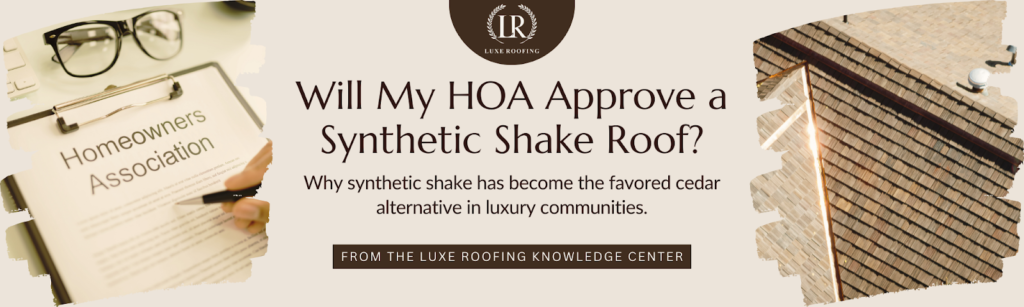
If you live in a Georgia or South Carolina neighborhood with an active HOA and you’re considering Brava synthetic shake roofing or another composite shake roof system, one question will determine how smoothly your project moves forward:
“Will my HOA approve a synthetic shake roof?”
The practical answer in 2026 is:
Yes. In most higher-end communities, premium synthetic shake—especially Brava—is approved and often preferred over natural cedar.
However, approval is not automatic. It depends on:
- Your neighborhood’s architectural guidelines
- The specific synthetic material you select
- The color and profile you propose
- The quality of the submission package
- How your roofing contractor communicates with the board
This guide explains how HOAs think about roofing, why synthetic shake has become the favored cedar alternative in luxury communities, and how a structured submission process makes approval predictable rather than stressful.
For a deeper dive into performance, color blends, cost, and lifespan, see our master resource:
Brava Synthetic Shake Roofing in Atlanta – The Ultimate 2026 Homeowner’s Guide.
1. Why HOAs Are Increasingly Approving Synthetic Shake Roofing
Across Georgia and South Carolina, HOAs have become more disciplined about roofing decisions. Their goal is simple: preserve architectural harmony, protect home values, and reduce long-term problems for residents.
Natural cedar shake no longer supports that objective in humid, storm-prone environments.
Cedar Shake Has Become Increasingly Problematic
Many boards have watched cedar roofs:
- Rot prematurely
- Turn black or streaked within a few years
- Curl, crack, and splinter
- Require constant cleaning and maintenance
- Age unevenly from home to home
This results in:
- Visual inconsistency
- Accelerated aging at the roofline
- More homeowner complaints
- Higher insurance complications
- Reduced curb appeal and property values
Insurance Carriers Have Followed the Same Pattern
Cedar shake now prompts many insurers to:
- Increase premiums
- Require periodic inspections
- Demand maintenance documentation
- Resist full replacement after storms
HOAs recognize that materials causing insurance friction eventually cause community-wide friction.
Why Synthetic Shake Solves These Issues
High-quality composite roofing, especially Brava Synthetic Shake, delivers:
- The realistic appearance of fresh cedar
- Long-term visual consistency across homes
- Zero rot, mold, or algae streaking
- Minimal color change over decades
- Strong wind and impact ratings
- A more favorable insurance profile
Synthetic shake allows HOAs to preserve the aesthetic they want without the ongoing problems associated with natural wood.
2. Why Brava Synthetic Shake Earns Approval More Often Than Many Other Composites
Not every synthetic shake roof is HOA-friendly. Boards often reject products that look artificial, including those that appear:
- Shiny or plastic
- Flat or monotone
- Overly uniform
- Inauthentically grained
Brava stands apart.
What Makes Brava HOA Compatible
✔ Authentic hand-split profile
Brava uses molds taken from real cedar, preserving natural irregularities and texture.
✔ Multi-blend color depth
Each shake incorporates layered tones that create natural variation.
✔ Matte finish
No gloss. No plastic look. No artificial shine.
✔ Long-term appearance stability
Roofs stay consistent for decades—no rot, streaking, or rapid color loss.
✔ Strong technical ratings
Impact, wind, and fire performance levels typically exceed natural cedar.
Because of this, Brava has been successfully approved in strict communities across:Atlanta, Alpharetta, Milton, Buckhead, Sandy Springs, Lake Oconee, Charleston, Hilton Head, Greenville, Daniel Island, and other architectural review districts across Georgia & South Carolina.
3. How to Determine Whether Your HOA Allows Synthetic Shake Roofing
The Ultimate Test of Material Flexibility**
Turrets, round rooms, and curved roof segments require materials that conform to curvature while maintaining pattern integrity.
Why Brava Excels on Turrets
Adaptable installation pattern
Individual shakes can be adjusted incrementally to follow curvature without forced seams.
Natural variation
Shake variation prevents the banded look that occurs when uniform panels wrap around curved planes.
Stable performance under circular wind patterns
Turrets face unique aerodynamic pressure. Brava protects fastening integrity even under multidirectional stress.
Appropriate historic-inspired character
Curved forms often pair best with natural-looking materials. Brava replicates cedar’s texture without its short lifespan.
Very few roofing systems handle curved structures without aesthetic compromise. Brava is one of the rare materials capable of doing so.
Category 1: “Cedar or Cedar-Equivalent Allowed”
Some guidelines state that cedar—or any product that “closely resembles cedar”—is acceptable.
In these cases:
- Brava often qualifies automatically.
- Approval is straightforward when the submission is clean and visual evidence is provided.
Category 2: “Approved Product List” Communities
These HOAs maintain a defined list of materials.
If Brava is on the list → instant approval.
If not:
- Boards typically review technical sheets, color samples, and photos
- Premium synthetics like Brava are often added upon review
Category 3: “Architectural Compatibility” Language
These HOAs don’t specify materials. They simply require roofs to match the neighborhood’s character.
Boards look for:
- Profile realism
- Color harmony
- Long-term consistency
Brava aligns extremely well with these requirements.
4. What HOAs Expect in a Roofing Submission Package
Boards approve faster when the contractor provides a polished, professional packet, which typically includes:
- High-quality product imagery
- Brava color blend samples
- Technical specifications
- Impact, fire, and wind certifications
- Warranty summary
- Underlayment and fastening details
- Manufacturer credentials
- Optional home-specific mockups or examples
A strong submission helps the board clearly visualize:
Why it benefits the entire community long-term
5. Why Some Synthetic Roofing Is Rejected (and How to Avoid It)
HOAs rarely reject synthetic shake because it’s synthetic.
They reject it when:
- It looks artificial
- It uses incorrect colors
- The contractor submits incomplete information
- The material doesn’t match neighborhood style
- The product has a poor track record
✔ Using Brava and a professional submission eliminates these issues almost entirely.
6. The HOA Submission Process (When Done Properly)
A well-run HOA approval process typically follows these steps:
Step 1: Architectural & Roof Review
- Drone photography
- Neighborhood aesthetic review
- HOA document review
Step 2: Material & Color Selection
- Choose a Brava profile and color blend that fits the home’s architecture
- Ensure alignment with surrounding properties
Step 3: Preparation of a Complete HOA Packet
Your submission includes:
- Product literature
- Technical ratings
- Sample photos
- Warranty details
- Color blend documentation
- Optional renderings
Step 4: Communication With the HOA
Depending on guidelines:
- Luxe submits directly, or
- We support the homeowner’s submission
Step 5: Response & Clarifications
We answer any board questions with clarity and documentation.
Step 6: Approval & Scheduling
Once approved, installation proceeds according to HOA working rules.
7. Strict or Historic HOAs Are Increasingly Accepting Synthetic Shake
Brava enhances styles that rely on varied geometry, including:
- Tudor inspired homes
- Craftsman and shingle style residences
- Lodge and mountain properties
- European and storybook architecture
- Transitional designs with layered massing
- Luxury lake and golf community homes
- High end farmhouses with multiple cross gables
Any design that depends on depth, variation, or ornamental roof structure gains clarity from synthetic shake.
8. Common HOA Questions About Synthetic Shake
“Does it really look like cedar?”
Yes — Brava is nearly indistinguishable from natural hand-split cedar.
“How will it look after 5, 10, or 20 years?”
It maintains its intended appearance without the black streaks or curling common to cedar.
“Does it meet fire and wind requirements?”
Yes — in most cases, it exceeds HOA-required performance.
“Will it disrupt neighborhood uniformity?”
No — synthetic shake typically improves uniformity due to stable aging.
“Is it considered an architectural upgrade?”
In most luxury communities, yes..
9. Will Your HOA Approve Synthetic Shake? The 2026 Reality
In most Georgia and South Carolina HOA-driven communities:
⭐ A properly selected and professionally presented Brava Synthetic Shake roof is very likely to be approved.
Boards value materials that:
- Preserve the look of cedar
- Reduce long-term maintenance issues
- Improve insurance outcomes
- Maintain neighborhood consistency
- Support long-term property values
Approved thoughtfully, synthetic shake benefits everyone in the community.
10. Schedule Your HOA-Ready Brava Consultation
If you want clarity on how your HOA is likely to respond, the next step is a private consultation.
You will receive:
- A review of your roof & architecture
- Guidance on the best Brava color blends for your home
- An analysis of your HOA’s guidelines
- A draft outline of a full approval-ready submission
- Insights into how similar communities have approved synthetic shake
Schedule Your Private Consultation
Limited availability each month to ensure white-glove handling of each HOA submission.